At the corner of Second and Madison, a nineteen-story tower has watched over downtown Memphis since 1910. It was built for a single purpose: to be the marketplace of the cotton capital of the world.
The cotton capital of the world
Memphis grew up on cotton. Founded in 1874, the Memphis Cotton Exchange set the grades and prices that governed the Mid-South's defining crop, and by the turn of the century the city had become the largest inland spot-cotton market on earth — the beating heart of an economy that moved hundreds of thousands of bales each year. Along Cotton Row on Front Street, buyers and "classers" judged handfuls of fiber by sight and touch, grading them "strict low middling" or "good ordinary," and sealed fortunes with a handshake.
It was an industry that demanded a marketplace worthy of it. In 1910 the Memphis Cotton Exchange joined with the Memphis Merchants Exchange to build one — a skyscraper that would give the trade a single, commanding home. They called it, simply, the Exchange Building.
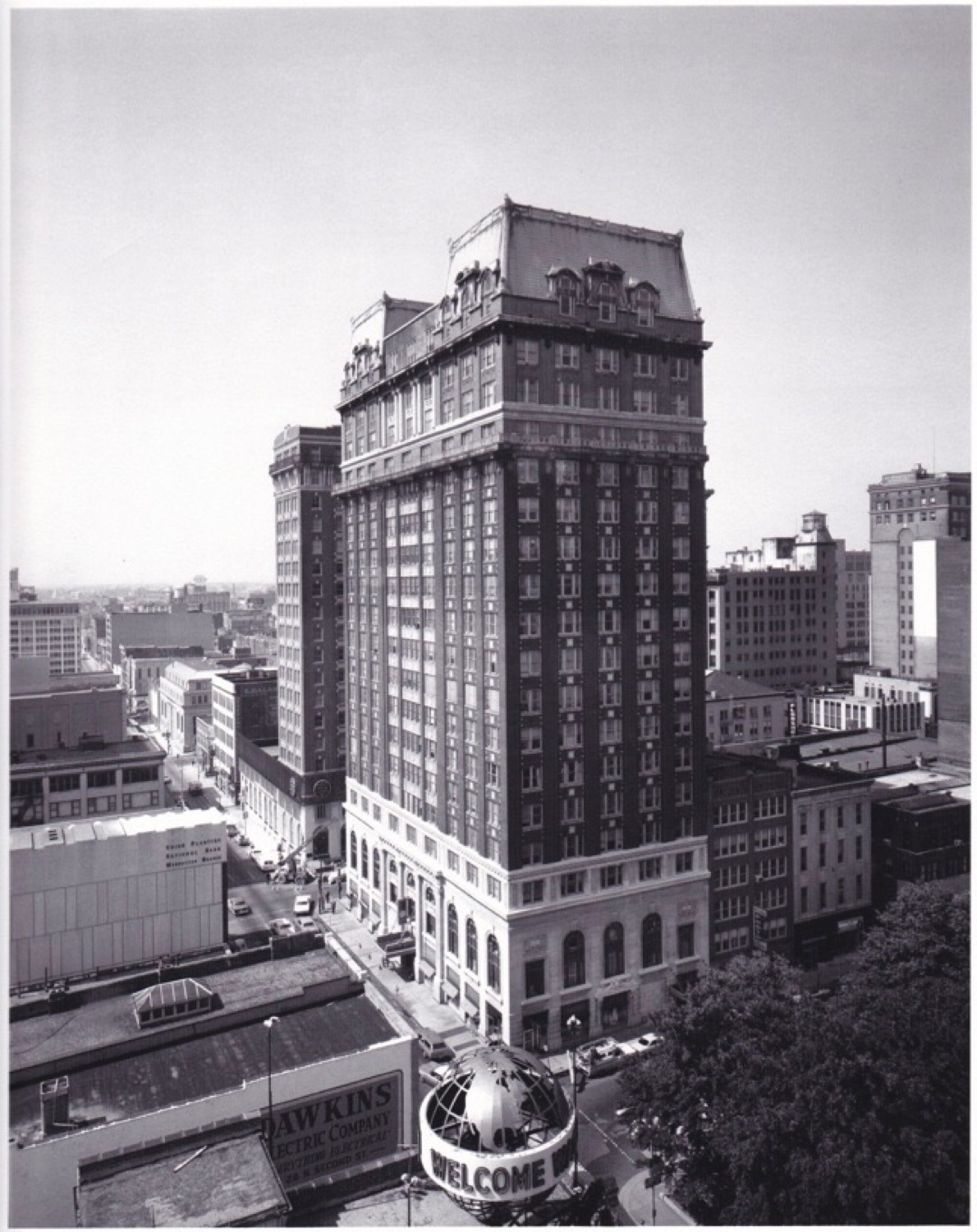
A tower rises
Designed by Memphis architect Neander M. Woods Jr. in the grand Beaux-Arts manner, the Exchange Building rose nineteen stories and 264 feet above the street, replacing an earlier 1885 cotton exchange on a site just south of Court Square. Framed in steel and concrete and dressed in Tennessee marble, granite, and ornamental plasterwork, it was the tallest building in Memphis — and in all of West Tennessee — from its completion until the Sterick Building surpassed it in 1930.
It was a statement in stone: that Memphis commerce had arrived, and that it intended to be seen.
Life on the trading floor
The commerce happened on the second floor. There, the day's cotton prices were chalked across enormous blackboards and updated throughout the trading day, while buyers and sellers called their bids aloud in a room thick with the business of the season. The building's interior matched the ambition of its trade — a grand staircase watched over by a brass lion, and a mosaic cotton bale set into the mezzanine floor, details that survive to this day.
For the merchants, brokers, and cotton men of the early twentieth century, this was the center of gravity of the Mid-South economy — the place where the price of the region's "white gold" was discovered, argued, and set.
A protected landmark
The Exchanges kept their home here into the 1920s, and the building remained a fixture of downtown long after. In recognition of its place in the city's history, the Exchange Building was listed on the National Register of Historic Places in 1979 as the Memphis Merchants Exchange — a permanent acknowledgment of the role it played in making Memphis a capital of American commerce.
A new chapter
In the 1990s the landmark began its second life, reborn as more than two hundred downtown residences within its historic walls. After years of careful stewardship and restoration by its current owners, the Exchange Building today blends the grandeur of 1910 with the comforts of modern living — a place where residents wake up inside one of the most significant buildings in Memphis history.
The trading floor has gone quiet, but the address still means what it always has: the center of it all.